For boat flotation and cavity filling, choose a two-part polyurethane pour foam with a density and yield suited to the job. TotalBoat 2 lb foam is a strong general-purpose option for lightweight, nonstructural marine applications; Oycevila’s 2 lb kit is aimed at flotation and insulation; and Fiberglass Supply Depot offers options in several densities and kit sizes. Compare the stated yield and intended use before choosing, and follow the product instructions for mixing and pouring.
| Product | Best suited for | Key detail |
|---|---|---|
| TotalBoat 2 lb, 2-gallon kit | General boat void filling | 1:1 mix; about five-minute cure at stated temperatures |
| Oycevila 2 lb kit | Flotation and insulation | Described as 94% closed cell |
| Fiberglass Supply Depot 2 lb, 1-gallon kit | Higher-volume lightweight filling | Produces 5 cubic feet |
| Fiberglass Supply Depot 4 lb, quart kit | Smaller, denser pours | Produces 1/2 cubic foot |
| TotalBoat 6 lb, 2-gallon kit | Rigid, high-density applications | Structural formula; 94% closed cell |
TotalBoat 2 lb Expanding Foam

Best for: Boat owners filling cavities or adding buoyancy in nonstructural areas who want a lightweight, versatile pour foam. TotalBoat specifies a two-part polyurethane formula with a simple 1:1 mix ratio. The product is listed as 94% closed cell and is intended for buoyancy, insulation, soundproofing, and filling gaps.
The foam expands rapidly and hardens in about five minutes at 70–80°F, according to the supplied product details. It can be cut or carved after curing and coated with polyester, epoxy, or vinyl ester resin. The listed features say it resists water absorption and damage from gas, oil, and solvents.
Limitation: This formula is for nonstructural applications only. For filling larger areas under a deck, the product information recommends pouring in separate batches.
Oycevila 2 lb Marine Foam Kit

Best for: Buyers seeking one foam for flotation support and marine insulation. Oycevila describes this two-part kit as forming a 94% closed-cell structure that expands to fill voids. Its listed uses include sailboats, kayaks, canoes, and other watercraft.
The product features also call out insulation for fish boxes, bait wells, and marine refrigeration units. That makes it a better fit than a flotation-only choice when temperature stability is part of the project. The supplied description says the cured foam is intended to withstand marine conditions, including saltwater exposure and impacts.
Limitation: The provided product details do not state a kit yield or cure time. Confirm the required volume and application instructions before planning a pour.
Fiberglass Supply Depot 2 lb Foam

Best for: Projects needing a larger volume of lightweight foam for nonstructural voids. This one-gallon kit contains equal parts of the two components and is listed to produce 5 cubic feet. The manufacturer describes it for buoyancy, soundproofing, insulation, and filling cavities, including spaces under decks.
Compared with the smaller TotalBoat kit, the stated yield makes this option useful when a project requires more material. Its equal-part mixing format is clearly specified, which helps buyers estimate the component quantities needed.
Limitation: The product is recommended for nonstructural void filling. Do not select it as a substitute for structural reinforcement.
Fiberglass Supply Depot 4 lb Quart Kit

Best for: Smaller jobs where a 4 lb density formula is preferable to a high-expansion 2 lb foam. The quart kit consists of one pint each of Part A and Part B and is listed to produce 1/2 cubic foot. It can provide flotation, insulation, or soundproofing, and the cured foam can be laminated with polyester, epoxy, or vinyl ester resin.
This is a practical option when a full gallon kit would provide more material than the project calls for. Its stated yield also gives buyers a clear basis for estimating coverage.
Limitation: Its listed output is only 1/2 cubic foot, so it is not the best fit for filling extensive cavities.
TotalBoat 6 lb Structural Foam
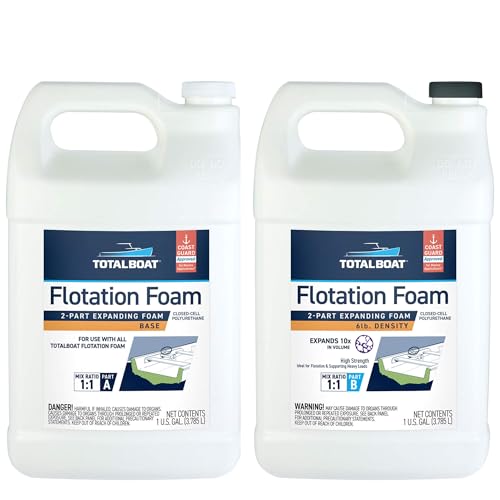
Best for: Projects where a rigid, high-density foam is needed for structural reinforcement, casting, or flotation. TotalBoat describes this two-part formula as curing hard with high compressive strength. It is listed as a 94% closed-cell foam that resists penetration by water, gas, and oil, and can be painted or used with epoxy, polyester, or vinyl ester resin.
Compared with 2 lb flotation foam, this product is the more suitable choice when rigidity is a priority. Its stated uses also include boat and buoy flotation, carving, and part fabrication.
Limitation: It is a high-density product intended to cure rigidly; choose a 2 lb option instead when high expansion and lightweight void filling are the main needs.
Buying Guide: How To Choose Closed Cell Flotation Foam
What density should you choose?
Density is a key comparison point. The listed 2 lb products are positioned for lightweight flotation and filling larger voids. The 4 lb option offers a denser formula in a smaller kit. The 6 lb TotalBoat foam is described as rigid and suited to structural reinforcement and fabrication. Match density to the intended application rather than assuming all pour foams perform alike.
How much foam does the project need?
Estimate the cavity volume before buying, then compare it with the stated yield. The Fiberglass Supply Depot 2 lb one-gallon kit produces 5 cubic feet, while its 4 lb quart kit produces 1/2 cubic foot. TotalBoat’s listed 2 lb product recommends separate batches for larger fills. Allow for the product’s expansion and follow its instructions.
Does closed-cell foam make the boat waterproof?
Closed-cell construction is intended to limit liquid absorption, but the supplied product descriptions do not establish that a foam installation makes a boat or cavity waterproof. Use the foam only as directed and consider how the surrounding structure is sealed and protected.
Should flotation foam be structural?
Check the product’s stated application. TotalBoat’s 2 lb foam is explicitly for nonstructural applications, while its 6 lb formula is described for structural reinforcement. Do not use a nonstructural product where a load-bearing or safety-critical component is required.
Frequently Asked Questions
What does closed-cell flotation foam do?
It can add buoyancy while filling cavities. Product features may also include insulation and soundproofing, depending on the formula.
Is 2 lb or 6 lb foam better for a boat?
Choose 2 lb foam for lightweight, higher-expansion void filling. Choose 6 lb foam when the product’s rigid, high-density characteristics better suit the project.
Can cured pour foam be covered with resin?
Several listed products state that cured foam can be laminated or coated with polyester, epoxy, or vinyl ester resin. Check the specific product instructions before coating.
How do I estimate the amount of foam to buy?
Measure the cavity volume and compare it with the product’s stated yield. The listed Fiberglass Supply Depot kits provide yield figures; not every product description supplied here does.
Add a Comment