The best 1/4-inch graph paper depends on how you plan to use it: School Smart is a strong choice for a large classroom supply, Oxford suits binder organization, and Zaviko and MSKKSM offer convenient top-bound pads. Mr. Pen combines loose-leaf convenience with a 55-sheet pad. The products below use a four-squares-per-inch grid, which creates 1/4-inch squares, except where the listing details do not specify the grid interval.
| Product | Format | Best For |
|---|---|---|
| School Smart | 500 loose sheets | Classrooms and bulk use |
| Oxford | 400 punched sheets | Three-ring binders |
| Zaviko | Two top-bound pads | Homework and removable sheets |
| MSKKSM | Two top-bound pads | Writing on the go |
| Mr. Pen | 55-sheet punched pad | Binder-ready notes |
School Smart 500-Sheet Graph Paper

Best for classrooms, study groups, or home users who need a large supply of standard-size graph paper. School Smart provides 500 white sheets measuring 8.5 by 11 inches, with a 1/4-inch grid. Its listing describes the paper as designed by education professionals and classroom tested.
Choose this option if quantity matters more than a bound pad or binder-ready pages. The listing does not specify whether the sheets are punched, bound, or printed on both sides, so check those details if your storage or copying needs depend on them.
Oxford 400-Sheet Binder Graph Paper
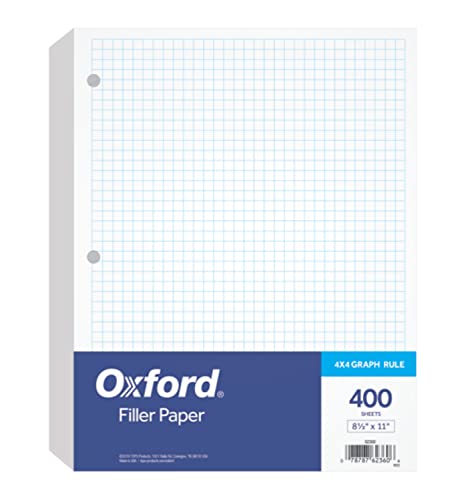
Best for students who want to keep graph work in a standard three-ring binder. Oxford’s pack contains 400 double-sided, 8.5-by-11-inch sheets with a four-squares-per-inch grid. The pages are three-hole punched and are intended for binder or fastener-style folder storage.
The grid suits math subjects such as geometry, calculus, and trigonometry, as well as physics and art. Choose Oxford over an unpunched pad if filing and rearranging pages are priorities. It is loose-leaf paper rather than a bound notebook, so pages need a binder or another way to stay organized.
Zaviko Two-Pack Graph Paper Pads

Best for homework, notes, and technical drawing when removable pages are useful. This set includes two 8.5-by-11-inch pads with 30 sheets each. The blue grid has four squares per inch, and the sheets are top-bound with perforations for removal.
The listing describes 70 GSM paper that can be used on both sides and is designed to resist ink bleed. Choose Zaviko if you want separate pads and tear-out sheets without binder holes. Avoid it if punched pages are essential for your filing system; the listed features do not describe binder-ready holes.
MSKKSM Two-Pack Graph Paper Pads

Best for users who want a portable pad with firm backing for writing away from a desk. The package includes two 8.5-by-11-inch pads with 30 sheets each and a four-squares-per-inch grid. Its listing describes 70 GSM double-sided paper and a cardstock backing intended to provide a stable writing surface.
The product is presented for math work, technical diagrams, sketches, lab reports, and organized notes. Choose it if a backing board is useful on a clipboard or other uneven surface. The listed features do not specify perforated sheets, so do not assume pages tear out as cleanly as those of a perforated pad.
Mr. Pen 55-Sheet Graph Paper Pad

Best for people who want the feel of a pad and the option to store sheets in a binder. Mr. Pen’s 8.5-by-11-inch quadrille paper has four squares per inch and comes in a 55-sheet pad. The sheets are three-hole punched to fit standard ring binders or folders with fasteners.
Choose this product for note-taking, engineering drawings, and technical work when punched pages are helpful. Compared with Oxford, it offers fewer sheets but comes as a pad. The product details provided do not state that the sheets are perforated, so check before choosing it specifically for clean tear-out pages.
Buying Guide: How to Choose 1/4-Inch Graph Paper
What does 1/4-inch graph paper mean?
On standard 1/4-inch graph paper, each small square measures one-quarter inch on each side. A four-squares-per-inch, or 4×4, grid describes the same spacing. This grid is commonly used for school math, charting, technical sketches, and organized notes.
Should you choose loose-leaf sheets or a pad?
Choose loose-leaf paper if you need to reorder pages, store work in a binder, or distribute sheets individually. Oxford and Mr. Pen list three-hole-punched pages. A top-bound pad, such as Zaviko or MSKKSM, keeps sheets together while you work. Check for perforations if neat removal is important.
How many sheets do you need?
For frequent classroom use or a shared supply, a 400- or 500-sheet pack reduces the need to restock often. For occasional homework or a dedicated project, a smaller pad may be easier to store and carry. Compare the total sheet count across all pads in a multipack.
What paper details should you check?
Confirm the page size, grid spacing, binding style, hole punching, and whether printing appears on one or both sides. If you plan to write on both sides or use ink, look for product details about paper weight and bleed resistance. These features vary by product, so do not assume every graph paper pack handles ink the same way.
Frequently Asked Questions
Is 4×4 graph paper the same as 1/4-inch graph paper?
Usually, yes. “Four squares per inch” means each square is 1/4 inch wide and 1/4 inch tall.
Which option is best for a three-ring binder?
Oxford and Mr. Pen list three-hole-punched sheets. Choose based on whether you prefer a large loose-leaf pack or a smaller pad format.
Can I use graph paper for math and technical drawing?
Yes. The listed products describe uses that include school math, engineering or technical drawing, notes, and sketches.
Are all these sheets standard letter size?
The five selected products are listed as 8.5 by 11 inches. Check the product details if exact dimensions are important for a particular notebook or folder.
Add a Comment